
Sits like a radiator Floor console units explained
Low Wall Air Conditioning: When a Floor Unit Beats a Wall Unit
Low wall air conditioning uses a floor console: an indoor unit about the size of a small radiator, fitted near the floor instead of high on the wall. It suits loft rooms with sloping ceilings, walls full of windows and homes where heating matters as much as cooling. This guide compares it with a standard high wall unit, with real sizes, noise figures and costs. Aircova fits both across London and the South East, at a fixed price in writing.
- Sizes and dB(A) from manufacturer spec sheets
- Honest advice on high wall vs low wall
- F-Gas certified engineers
Last updated: October 2026. Prices last checked: October 2026
See how it works
Low wall air conditioning in three short clips
High wall or low wall, when low wall is the better choice, and heating in winter.

The short answer
What is low wall air conditioning?
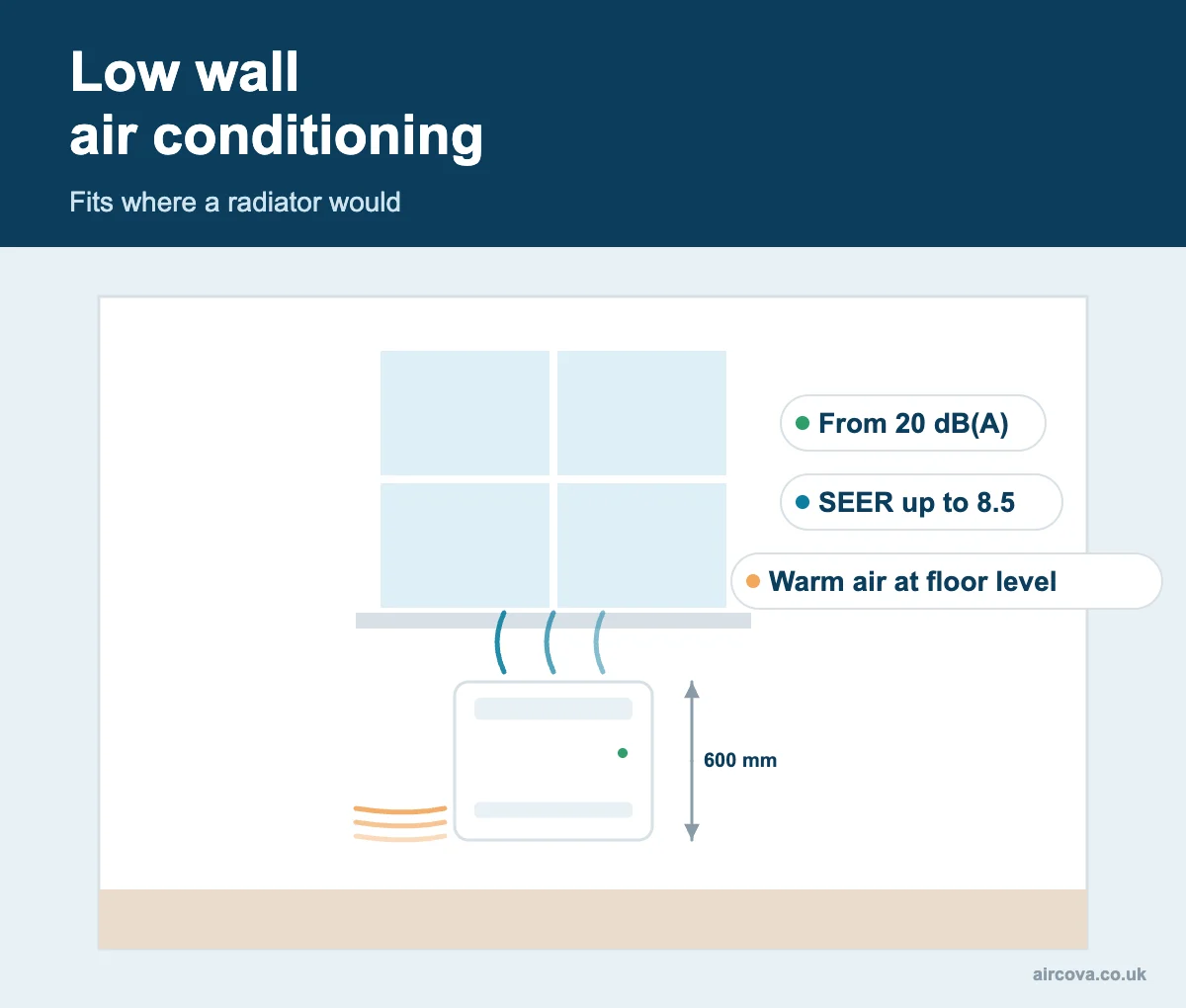
Low wall air conditioning is a split system with a floor console indoor unit fitted just above the skirting board, usually about 600mm high and 750mm wide. It works like a high wall unit, with a quiet outdoor unit outside, but it sits where a radiator would. Choose it when there is no space high on the wall, or when heating is the main job.
Installers also call it a floor-standing, floor-mounted or console air conditioner. The outdoor unit, pipework and refrigerant are the same as any split system. Only the indoor unit and where it goes are different.
| Feature | Low wall (floor console) | High wall unit |
|---|---|---|
| Where it sits | Just above the floor, like a radiator | High on the wall, near the ceiling |
| Typical size (2.5kW) | About 600 x 750 x 200mm | About 300mm high, 800 to 900mm wide |
| Quietest indoor level | From about 20 dB(A) | From about 19 dB(A) |
| Best at | Heating, sloping ceilings, window walls | Cooling large rooms, saving floor space |
| Fitted price | Priced at survey | From £2,195 fitted at Aircova |
Console sizes and noise from Mitsubishi Electric MFZ-KW25 and Fujitsu AGYG09KVCA data sheets. High wall figures from the models in our quietest air conditioning guide.
Most rooms suit a high wall unit. If you have a clear wall above head height, a standard unit is usually cheaper and spreads cool air further. See sizes and fixed prices on our wall-mounted air conditioning page.
Where it fits
When a low wall unit is the better choice
A floor console earns its place when a high wall unit would not fit, would look wrong, or would struggle to heat the room. These are the homes where we suggest one most often.
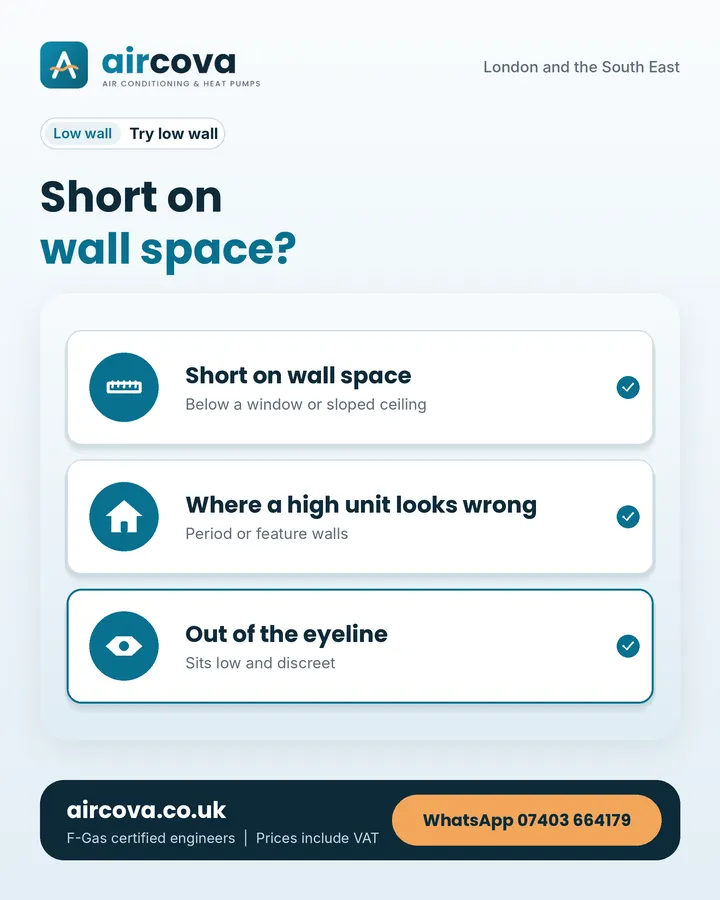
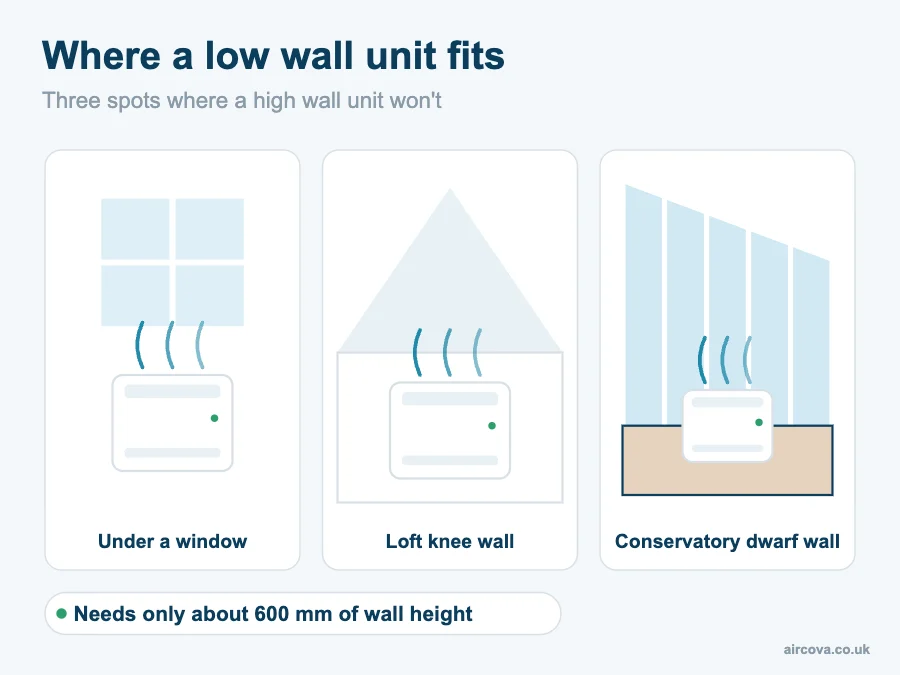
- Loft rooms with sloping ceilings. Short knee walls leave no space high up, but a console fits under the slope.
- Walls full of windows. Bay windows, glazed extensions and garden rooms often have no solid wall near the ceiling.
- Replacing radiators or heaters. A console can go where an old radiator, storage heater or panel heater was.
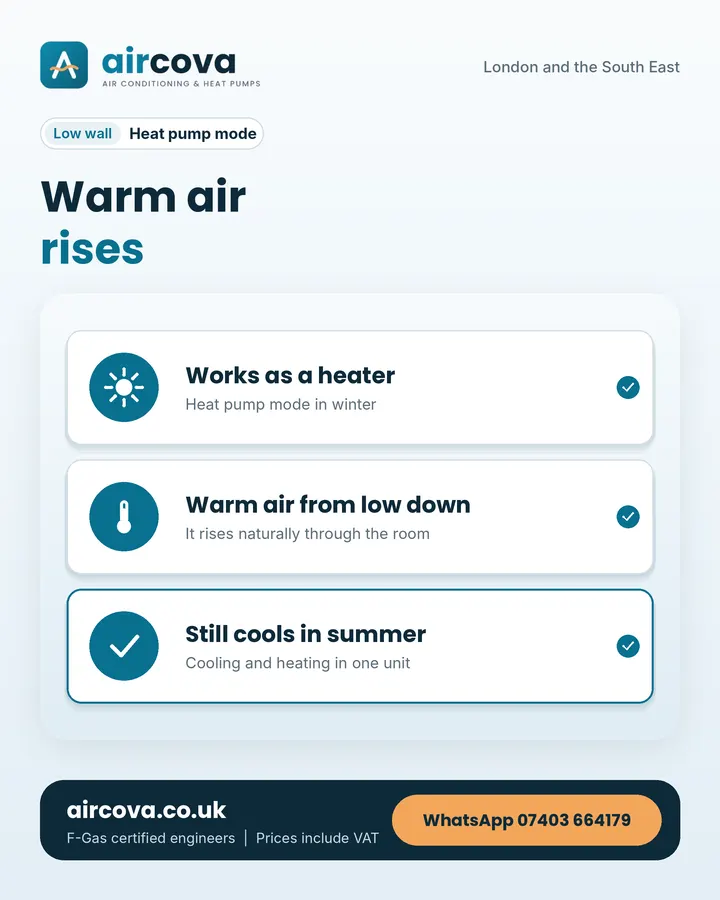
- Heating as the main job. Warm air leaves near the floor and rises through the room, rather than collecting at the ceiling.
- Easy reach. Filters can be cleaned without a stepladder, which helps older owners.
Our loft air conditioning page covers knee walls and eaves in more detail.
Models compared
Popular low wall units from the main brands
The leading brands all make floor consoles, and the best match top high wall units on efficiency. The figures below come from each maker’s specification sheets.
| Model | Size (H x W x D) | Indoor noise | Efficiency (SEER / SCOP) |
|---|---|---|---|
| Mitsubishi Electric MFZ-KW25 (2.5kW) | 600 x 750 x 215mm, 145mm when part-recessed | 20 to 39 dB(A) | 8.5 / 4.1 |
| Fujitsu AGYG09KVCA (2.5kW) | 600 x 740 x 200mm | 22 to 40 dB(A) | 8.5 / 4.3 |
| Daikin Perfera FVXM50 (5kW) | 600 x 750 x 238mm | Up to 44 dB(A) on high | 7.3 / 4.31 |
Sources: Mitsubishi Electric MFZ-KW25 data sheet, Fujitsu AGYG09KVCA specifications, and the Daikin FVXM50 listing from a UK distributor.
The Mitsubishi Electric console can be part-recessed into a stud wall, so it sticks out only about 145mm. We fit Daikin, Mitsubishi Electric and Fujitsu consoles, and most can share one outdoor unit with high wall units on a multi-split system.
In numbers
A low wall unit as a heater
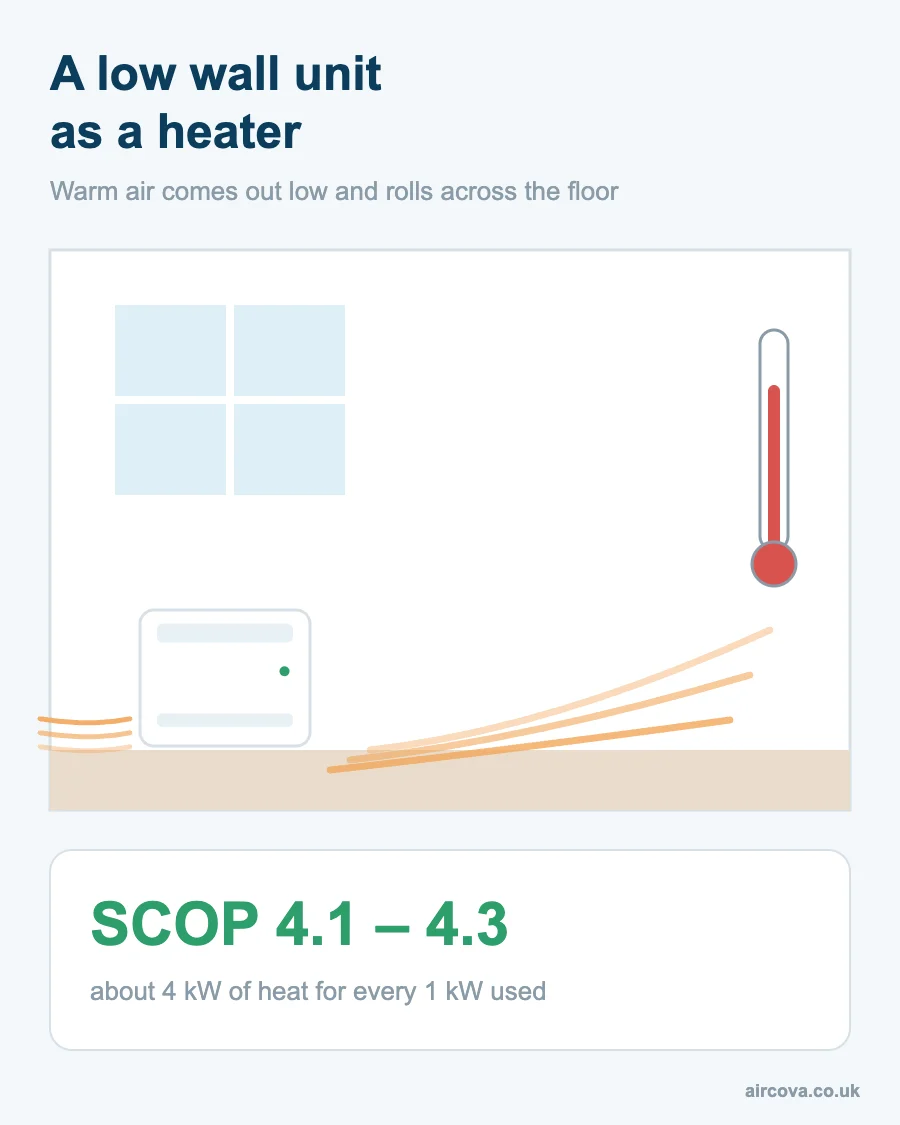
A floor console is a heat pump. In winter it moves warmth in from the outside air, so it gives far more heat than the electricity it uses. That makes it a strong replacement for an old radiator or electric heater in the same spot.
Because warm air leaves at floor level, the room heats evenly from the bottom up. For cooling, the louvres send air upwards instead.
See how heating with a split system works on our air-to-air heat pump page, and the yearly sums in our running costs guide.
Pros and cons
Low wall air conditioning: the honest trade-offs
Pros
- Fits under sloping ceilings and below windows
- Heats a room evenly from floor level
- Can replace a radiator or heater in the same spot
- Filters are easy to reach and clean
- Top models match high wall units on efficiency
Cons
- Uses wall space you might want for furniture. Sofas and beds must not block the airflow.
- Less reach when cooling big rooms. A high wall unit throws cool air further across an open plan space.
- Easier to knock. Children, pets and vacuum cleaners can reach it.
- Usually costs more. The console indoor unit is dearer than a standard wall unit.
Cost and fitting
How much does low wall air conditioning cost?
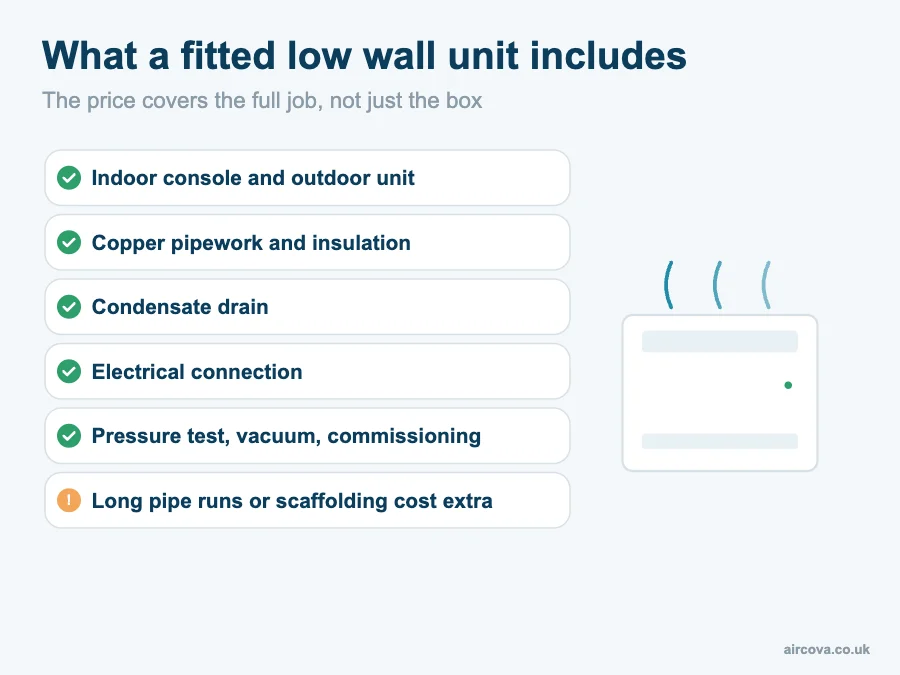
The fitting work is much the same as a high wall unit: one wall hole, an outdoor unit on a bracket or ground stand, pipework, a drain and an electrical supply. The difference is the indoor unit, which costs more, so a low wall system usually comes in above a high wall system of the same size.
For comparison, a high wall unit for one room starts from £2,195 fitted at Aircova, including VAT. We price floor consoles after a short survey, because the model, the pipe route and where the drain runs all change the figure. Our air conditioning cost guide sets out every system and size.
Things that affect the price
- The brand and kW size of the console
- Whether it is part-recessed into a stud wall
- Pipe length to the outdoor unit
- How the condensate drain can fall, or whether it needs a small pump
- Whether it joins other rooms on a multi-split
Most single consoles are fitted in a day. Pipes can usually leave the back, side or bottom of the unit, so they are easy to hide. Not sure of the size? Our BTU calculator gives a first figure for the room.
Choosing
High wall or low wall: which is right for you?
Pick a high wall unit when there is clear wall space up high and cooling matters most. Pick a low wall console when there is no high wall, when heating is the priority, or when it replaces a radiator.
| Your room | Our usual recommendation |
|---|---|
| Bedroom or lounge with a clear wall above head height | High wall unit, the simplest and lowest cost option |
| Loft room with sloping ceilings | Low wall console on the knee wall |
| Bay window, glazed extension or garden room | Low wall console below the glass |
| Room heated by an old radiator or electric heater | Low wall console in the same spot |
| Large open plan space, cooling first | High wall unit, or a ducted system for a hidden finish |
| Several rooms with different layouts | A multi-split mixing high wall and low wall units |
Want nothing on show at all? Read about ducted air conditioning, or our guide to air conditioning without an outdoor unit if the outside of the building is the problem.
FAQs
Low wall air conditioning: your questions
What is a low wall air conditioning unit?
It is a split system air conditioner with a floor console indoor unit, fitted low on the wall just above the skirting board. It is about the size of a small radiator, roughly 600mm high and 750mm wide, and connects to an outdoor unit like any split system.
Is low wall air conditioning better than high wall?
Neither is better in every room. A high wall unit is usually cheaper and spreads cool air further. A low wall unit is better under sloping ceilings, below windows, and where heating is the main job, because warm air leaves at floor level.
Are floor standing air conditioners noisy?
No. Good floor consoles are rated from about 20 dB(A) on their lowest setting, close to the quietest high wall units at 19 dB(A). The compressor, which is the noisy part, sits in the outdoor unit.
Does a low wall unit need an outdoor unit?
Yes, a split floor console needs an outdoor unit, the same as a high wall unit. If an outdoor unit is not allowed, a through-wall monobloc is the usual alternative.
Can a floor console replace a radiator?
Often, yes. A console can sit where a radiator or electric heater was and heat the room as a heat pump, giving around 4kW of heat for each 1kW of electricity on the best models.
Can I mix low wall and high wall units?
Yes. Most brands let floor consoles and high wall units share one outdoor unit on a multi-split, so each room gets the indoor unit that suits it.
How much does low wall air conditioning cost?
It usually costs more than a high wall unit of the same size, because the console indoor unit is dearer. A one room high wall unit starts from £2,195 fitted at Aircova, and we price consoles after a short survey.
Get your fixed price
Tell us about the room, where the indoor unit could go and how it is heated now. We will tell you honestly whether a high wall or low wall unit suits it best, and send you a fixed price.
- Reply within an hour
- Free home survey
- Price confirmed in writing
Prefer to chat? WhatsApp us on 07403 664179
Monday to Friday 8am to 6pm, Saturday 9am to 5pm
We only use your details to prepare your quote. See our privacy policy.