
Year-round use Garden offices, studios and log cabins
Garden Room Air Conditioning: Cool Summers, Warm Winters
Garden room air conditioning turns a garden office, studio or log cabin into a space you can use all year. One split system cools it on hot afternoons and heats it on cold mornings for a fraction of the cost of a panel heater. This guide covers the right size of unit, the power supply most people forget, where the outdoor unit goes, planning rules and real fitted costs. Aircova fits garden room systems across London and the South East at a fixed price in writing.
- Sized for heating as well as cooling
- Power supply checked at survey
- F-Gas certified engineers
Last updated: October 2026. Prices last checked: October 2026

See how it works
Garden room air conditioning in three short clips
What a garden room needs, power and outdoor unit position, and heating and cooling all year.


The short answer
Can you put air conditioning in a garden room?
Yes. A wall-mounted split system is the usual choice for a garden room or garden office. Most need a 2.5kW or 3.5kW unit, a dedicated electrical circuit from the house and an outdoor unit fixed to the back or side of the building. Because it is a heat pump, the same unit heats the room in winter as well as cooling it in summer.
Garden rooms heat up and cool down far faster than a house. They have thinner walls, large glazed doors and no heating from rooms next door. That is why a timber office can hit 30°C on a sunny June afternoon and feel cold on a February morning. A split system deals with both, and it can be switched on from your phone before you walk down the garden.
What size air conditioning unit does a garden room need?
Size it for the floor area, then adjust for glazing and insulation. A well-insulated garden office with one set of doors sits at the lower end of each range. A room with a fully glazed front, roof lights or thin walls needs the next size up.
| Garden room floor area | Usual unit size | Typical use |
|---|---|---|
| Up to about 12m² | 2.0kW to 2.5kW | Small garden office or studio |
| 12m² to 20m² | 2.5kW, or 3.5kW if heavily glazed | Most garden offices and gyms |
| 20m² to 30m² | 3.5kW | Larger garden room or annex |
| 30m² to 40m² | 5.0kW | Open plan garden building |
Sizes follow the same guidance we use for rooms in the house. For a closer figure based on your room, ceiling height and sun, use our air conditioning BTU calculator.
Most garden rooms suit a standard wall unit. It sits high on the back wall, out of the way of your desk. See sizes and fixed prices on our wall-mounted air conditioning page.
The bit most people miss
Power supply for garden room air conditioning
An air conditioning unit should be on its own circuit, so the power to your garden room matters. Some garden rooms are built with only a few sockets fed from a light supply, which is not enough. Before we quote, we check how your garden room is wired.
- Armoured cable from the house. A garden room supply is normally a buried steel wire armoured cable from your consumer unit, sized for the load and the length of the run.
- A small consumer unit in the garden room. The cable feeds a sub-board with RCD protection, which gives the air conditioning its own breaker.
- Notifiable under Part P. A new circuit is notifiable building work, so a registered electrician should do it and give you a certificate. See the government’s Approved Document P.
- Never an extension lead. Running an air conditioning unit from a cable through a window is unsafe and not allowed.
If your garden room already has a proper sub-board with spare capacity, we usually connect to it on the day. If it does not, a new supply is the first job. Electricians typically quote around £800 to £1,500 for a basic garden room supply with a short trenched run, more for long runs or hard surfaces to cross.

Placement
Where the outdoor unit goes
The outdoor unit normally sits on the garden room itself, not the house. That keeps the pipe run short, often well inside the 3 metres included in our price, and avoids digging a pipe trench across the garden.
- Back or side wall. A wall bracket on the rear or side of the building keeps the front clear.
- Ground stand. On a lightweight timber wall, a ground stand on a slab is often better than a bracket.
- Away from neighbours. Garden rooms often sit near a boundary, so we place the unit away from the next-door windows and patio.
- Room to breathe. The unit needs clear air around it, so it should not be boxed in behind a fence or shed.
- Somewhere for the water. Condensate from the indoor unit runs to a gutter, a gravel soakaway or a drain.
Glazed fronts and low walls can make a high wall unit awkward. In that case a floor console under the window often works better, as our guide to low wall air conditioning explains. For glass rooms attached to the house, read our conservatory air conditioning guide.

Heating costs
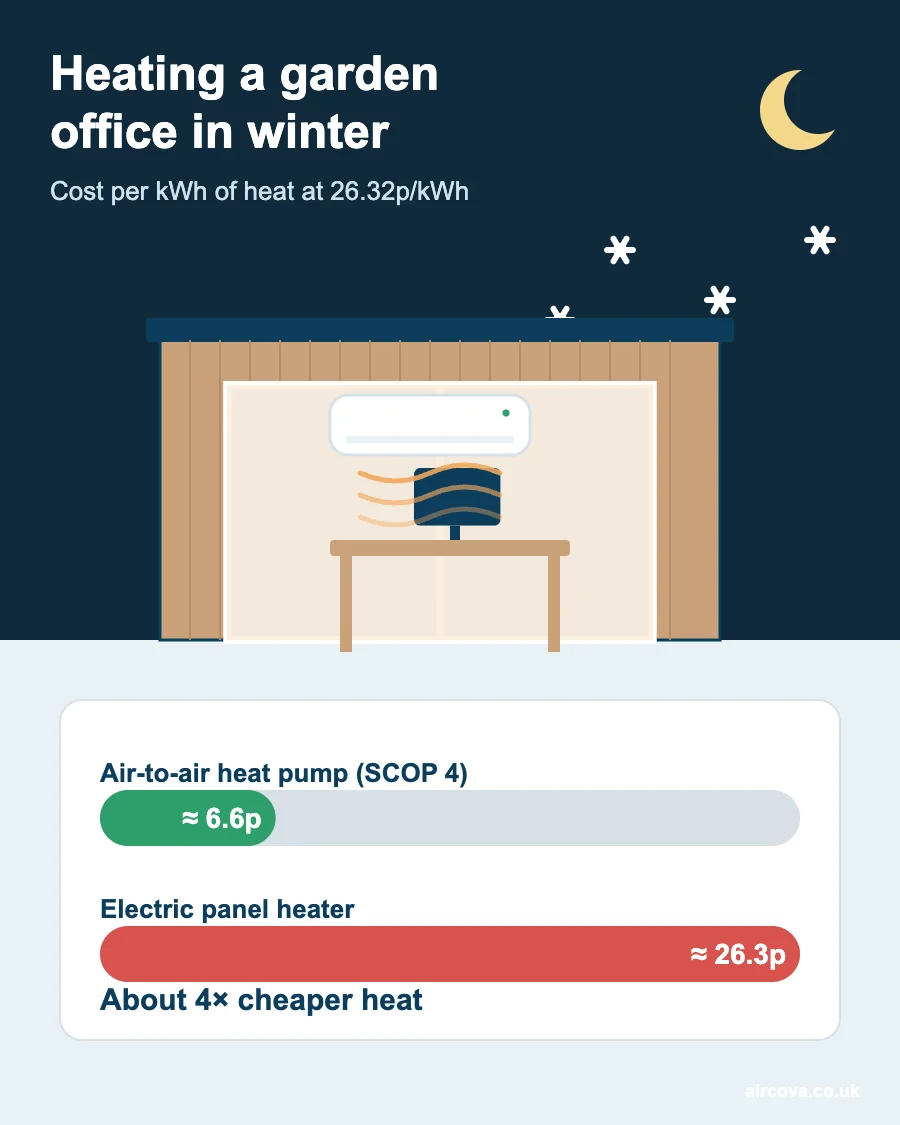
Heating a garden office in winter
Heating is where garden room air conditioning really pays for itself. A split system is a heat pump: it moves warmth in from the outside air, so it gives out far more heat than the electricity it uses. A panel or oil-filled heater turns 1kW of electricity into just 1kW of heat.
Those figures use the Ofgem price cap electricity rate of 26.32p per kWh for October to December 2026. As an example, a garden office that needs 10kWh of heat on a cold day costs about 66p to heat with a heat pump, against about £2.63 with a panel heater.
See how heating with a split system works on our air-to-air heat pump page, and the full sums in our air conditioning running costs guide.
Rules
Do you need planning permission for garden room air conditioning?
Usually not, as long as the unit heats as well as cools. The Planning Portal says permitted development rights only apply to systems with a heating function, so a cooling-only unit needs planning permission. Conservation areas and listed buildings need permission or consent.
- Choose a heat pump model. Every split system we fit heats and cools, which is what permitted development requires.
- Mind the size and noise limits. Since May 2025 an outdoor unit can be up to 1.5 cubic metres and must meet the MCS 020(a) noise standard.
- Not on a pitched roof. On a garden room, that usually means a wall bracket or ground stand.
- Check protected areas. In a conservation area, or at a listed building, speak to your council before you book.
Our air conditioning planning permission guide covers every limit in detail, and you can read the official answer on the Planning Portal. The garden room itself has its own outbuilding rules, which your garden room builder should have checked.
Fitted cost
How much does garden room air conditioning cost?
A 2.5kW wall-mounted unit for a garden room starts from £2,195 fitted at Aircova, including VAT, and a 3.5kW unit from £2,395. If the garden room has no suitable power supply, budget separately for an electrician.
| Item | Typical cost | Notes |
|---|---|---|
| 2.5kW wall-mounted unit, fitted | From £2,195 | Aircova fixed price with VAT, up to 3m of pipe |
| 3.5kW wall-mounted unit, fitted | From £2,395 | For larger or heavily glazed garden rooms |
| Daikin or Mitsubishi Electric | Add £200 | Quieter premium models |
| New power supply from the house | Around £800 to £1,500 | By an electrician, only if no suitable supply exists |
| Extra pipework | Priced at survey | Only if the outdoor unit sits away from the room |
Our prices include the indoor and outdoor units, up to 3 metres of pipe, the bracket, connection to a suitable supply, commissioning and VAT. See every system and size in our air conditioning cost guide.
Before you book: a quick checklist
- Is the garden room insulated in the walls, floor and roof?
- Does it have its own sub-board, or only sockets on a light supply?
- Is there space on a back or side wall, or level ground, for the outdoor unit?
- How big is the room, and how much of the front is glass?
- Do you want to control it from your phone before you head out?
FAQs
Garden room air conditioning: your questions
Can you put air conditioning in a garden room?
Yes. A wall-mounted split system is the usual choice. It needs a dedicated electrical circuit and an outdoor unit on the back or side of the garden room, and it heats as well as cools.
What size air conditioner do I need for a garden office?
Most garden offices of 12 to 20m² need a 2.5kW unit, or 3.5kW if the front is heavily glazed. Rooms of 20 to 30m² usually need 3.5kW, and 30 to 40m² about 5kW.
Does garden room air conditioning need its own electrical supply?
It should have its own circuit. That normally means an armoured cable from the house to a small consumer unit in the garden room. A new circuit is notifiable under Part P, so use a registered electrician.
Can air conditioning heat a garden room in winter?
Yes. A split system is a heat pump, giving around 3 to 4kW of heat for every 1kW of electricity. That makes it far cheaper to run than a panel or oil-filled heater.
Do I need planning permission for air conditioning on a garden room?
Usually not, if the unit heats as well as cools and meets the permitted development limits on size and noise. Cooling-only units, conservation areas and listed buildings need permission.
Where does the outdoor unit go on a garden room?
Usually on a bracket on the back or side wall, or on a ground stand beside the building. That keeps the pipe run short and the unit away from neighbours.
How much does garden room air conditioning cost?
A 2.5kW unit starts from £2,195 fitted at Aircova, including VAT, and a 3.5kW unit from £2,395. A new power supply, if needed, typically costs around £800 to £1,500 from an electrician.
Get your fixed price
Tell us the size of your garden room, how it is powered and where the outdoor unit could go. We will check the details and send you a fixed price for cooling and heating it all year.
- Reply within an hour
- Free home survey
- Price confirmed in writing
Prefer to chat? WhatsApp us on 07403 664179
Monday to Friday 8am to 6pm, Saturday 9am to 5pm
We only use your details to prepare your quote. See our privacy policy.