
Glass rooms Cooling in summer, heating in winter
Conservatory Air Conditioning: Cost, Size and the Right System
Yes, you can put air conditioning in a conservatory, and a split system that heats as well as cools is usually the best way to make one usable all year. The catch is glass. A conservatory gains heat faster in summer and loses it faster in winter than any other room, so it needs a bigger unit than its floor area suggests and a careful choice of where the unit goes. This guide covers sizing, placement, building regulations and fitted prices. Aircova fits air conditioning across London and the South East, at a fixed price in writing.
- Sized with the same method as our BTU calculator
- Heating and cooling from one unit
- F-Gas certified engineers
Last updated: November 2026. Prices last checked: November 2026
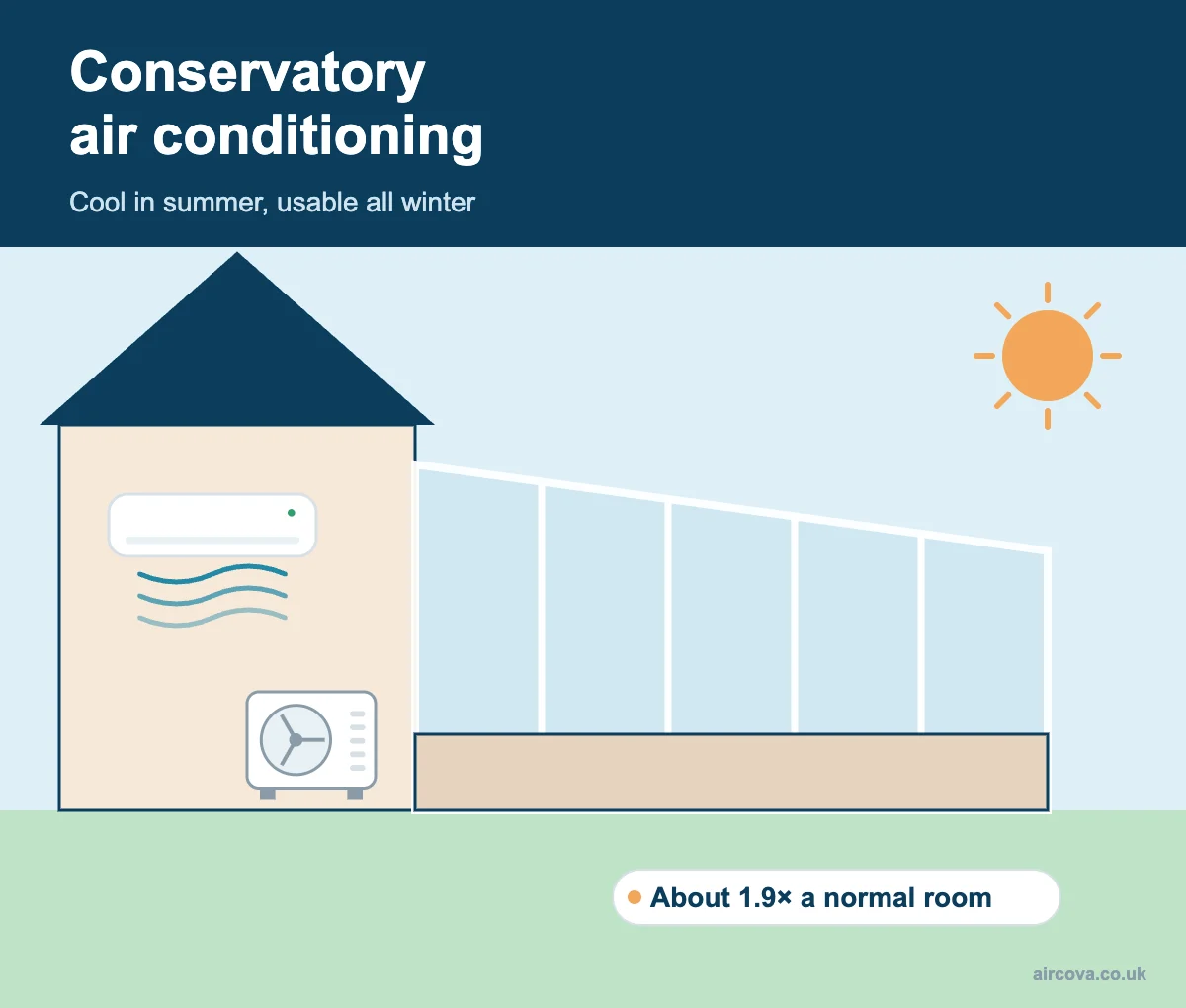
See how it works
Conservatory air conditioning in three short clips
Why conservatories overheat, how they differ from a normal room, and where the units go.

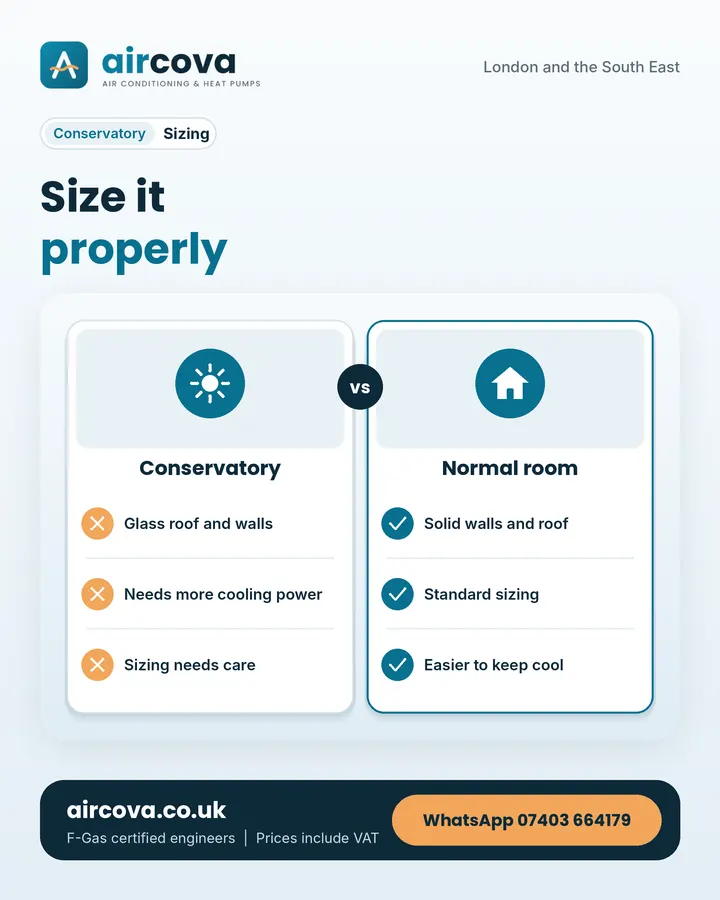
The short answer
Can you put air conditioning in a conservatory?
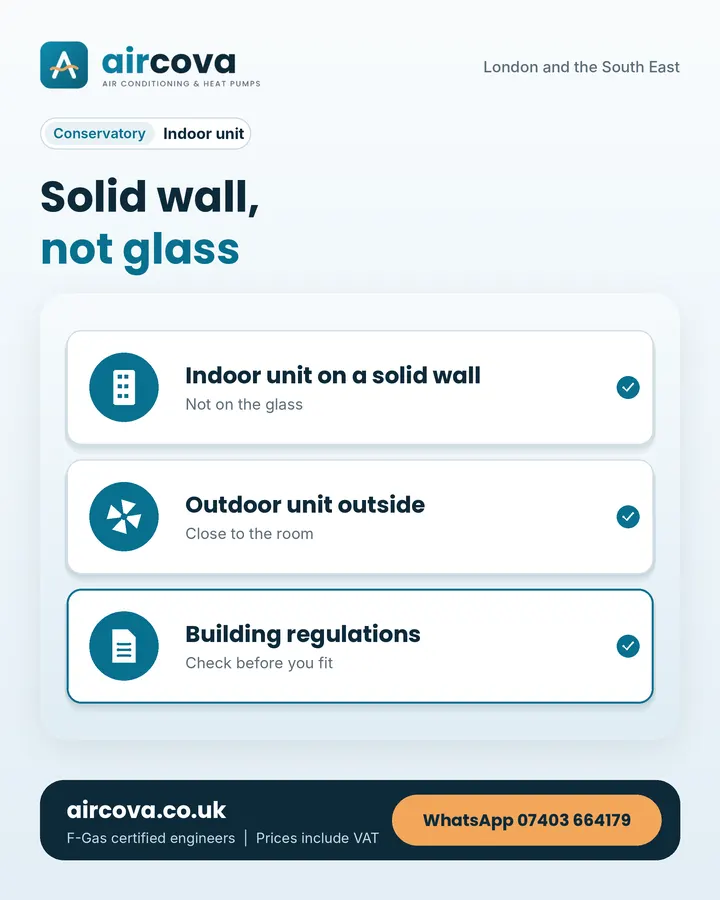
Yes. The usual choice is a split system: an indoor unit fixed to the solid house wall or a brick dwarf wall, a small pipe through the wall and an outdoor unit outside. A split that works as an air-to-air heat pump also heats the conservatory in winter, so one system makes the room usable all year.
Most people looking into this have the same problem. The conservatory is too hot to sit in from late spring and too cold to use from November, so an expensive room spends half the year as a store for garden chairs. Fans and portable units help a little in summer and do nothing in winter. A fitted system fixes both, as long as it is sized for glass and placed on a wall that can hold it.
| Option | Where it goes | Heats in winter? | Best for |
|---|---|---|---|
| Wall-mounted split | High on the solid house wall inside the conservatory | Yes, on heat pump models | Most conservatories, and the lowest fitted price |
| Floor-standing console | Low on a brick dwarf wall, roughly the size of a radiator | Yes, and warm air starts at floor level | Conservatories with no tall solid wall |
| Multi-split | Conservatory plus other rooms on one outdoor unit | Yes | Cooling the conservatory and a bedroom or kitchen too |
| Portable unit | On the floor, with a hose through a window or door | Rarely, and weakly | Occasional use while you decide |
Ducted systems are rarely practical in a conservatory, because there is no ceiling void to hide the indoor unit in.
Thinking about a portable unit first? In a glass room it usually struggles, because the hot air it pushes out through the hose leaks straight back in. Our portable vs split air conditioning guide compares the two on noise, power and running cost.
Why it is different
Why a conservatory needs more than a normal room
A bedroom with one window has solid walls and a ceiling with another room or a loft above it. A conservatory is mostly glass on the walls and the roof, so it behaves very differently.
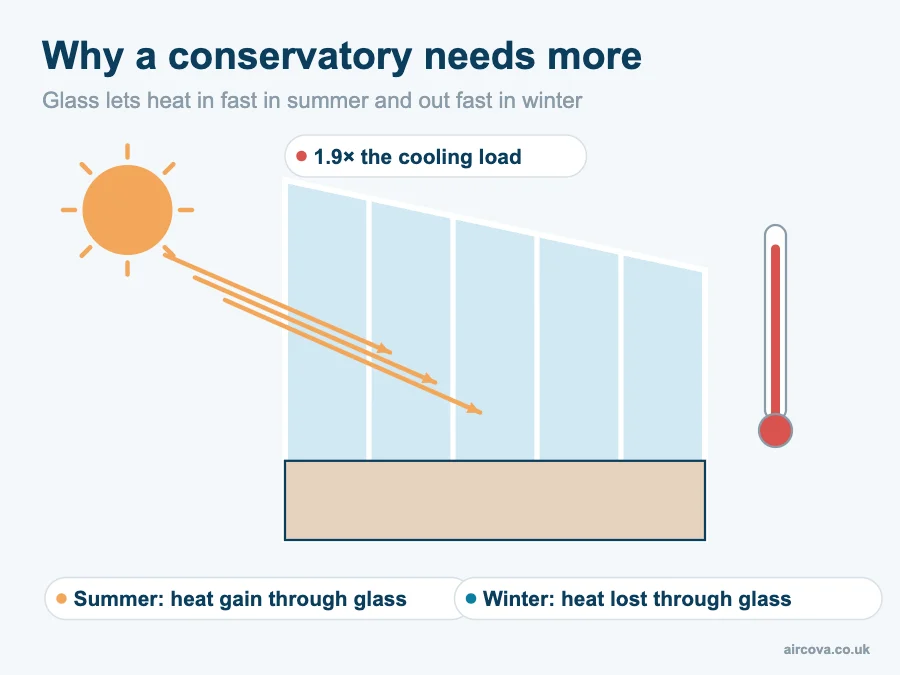
- Summer heat gain. Sun comes through the roof as well as the sides, for most of the day. A south or west-facing conservatory takes the most.
- Winter heat loss. Glass and thin roof panels hold heat poorly, so the room cools quickly once the sun goes down.
- Fast swings. The temperature can change sharply in an hour as cloud comes and goes, so the system needs headroom rather than running flat out.
- The roof matters most. A polycarbonate roof usually lets in more heat in summer and loses more in winter than a modern glass or solid roof.
This is why we treat a conservatory as a special case. Our sizing adds a fixed allowance for the glass, then checks winter heat loss as well, because in a poorly insulated conservatory the heating demand can decide the size rather than the cooling.
How your conservatory roof changes the answer
| Roof type | Summer | Winter | What it means for sizing |
|---|---|---|---|
| Polycarbonate | Hottest | Coldest | Treat as poor insulation, which usually means a size up |
| Glass, older double glazing | Hot | Cold | Standard conservatory allowance, plus strong sun if it faces south or west |
| Modern solar control glass | Warm | Cool | Standard conservatory allowance |
| Solid or tiled replacement roof | Closer to a normal room | Closer to a normal room | Can bring the size down, as the roof no longer lets the sun in |
We confirm the roof and glazing on the survey, because two conservatories of the same size can need different units.
Sizing
What size air conditioner does a conservatory need?
We size every room the same way, and a conservatory simply gets bigger allowances. Start with the floor area, then adjust:
- Base load: 100 to 125 watts of cooling for each square metre of floor.
- Conservatory: add 40% for the glass walls and roof.
- Strong sun: add 10% if it faces south or west.
- Poor insulation: add 15% for a polycarbonate roof or single glazing.
- Height: scale up if the average ceiling height is above 2.4 metres.
- People: add 100 watts for each regular user beyond two.
Then pick the next unit size up. Wall units usually come in 2.0, 2.5, 3.5, 5.0 and 7.0kW. If you would rather not do the sums, our BTU calculator has a conservatory setting and gives the same answer.
Three conservatories, worked out
| Conservatory | What we measured | Cooling need | Unit size |
|---|---|---|---|
| Small lean-to | 3.5 by 3m, 2.4m average height, glass roof, partly shaded, two people | About 1.7kW, or 5,600 BTU/h | 2.0kW, though many people choose 2.5kW for headroom on hot days |
| Victorian style, south facing | 4 by 3.5m, 2.7m average height, polycarbonate roof, full sun, two people | About 3.1kW, or 10,700 BTU/h | 3.5kW |
| Large P-shape used as a dining room | 6 by 4m, 2.7m average height, polycarbonate roof, full sun, usually four people | About 5.6kW, or 19,000 BTU/h | 7.0kW, or two smaller units on a multi-split for more even air |
Figures use the midpoint of our 100 to 125 W/m² range with the adjustments above, the same method as our BTU calculator. A survey confirms the final size.
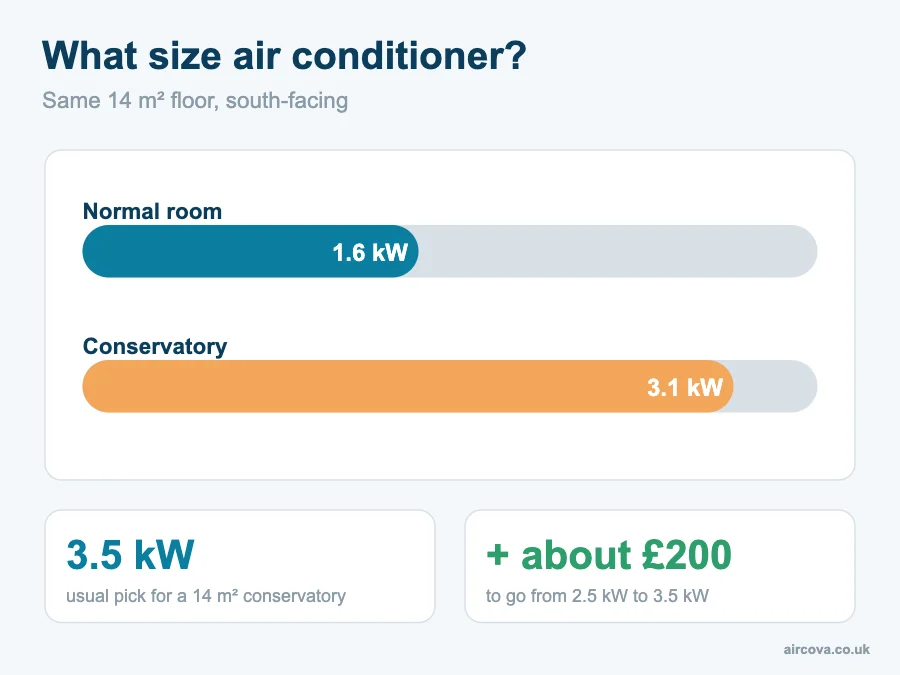
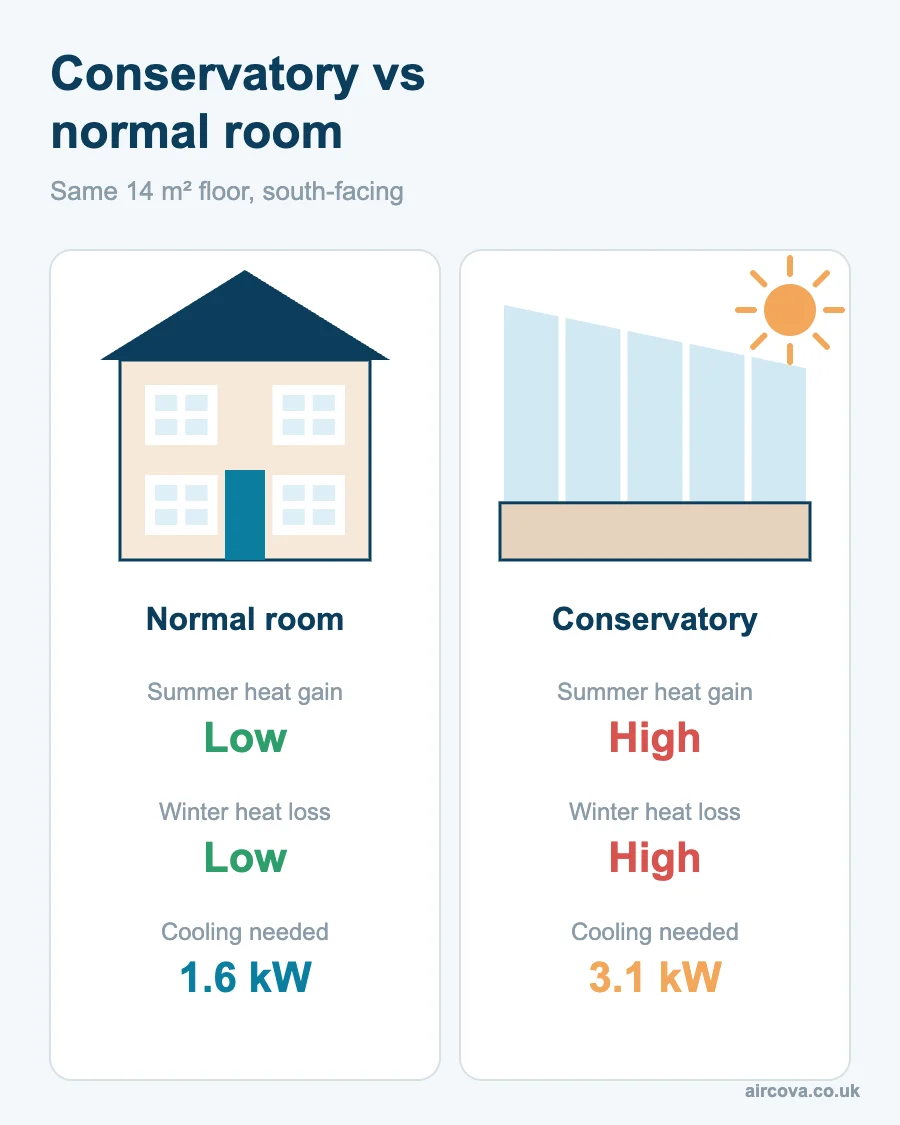
The south-facing example shows how much the roof matters. The same 14m² conservatory with modern glass instead of polycarbonate would need about 2.7kW, while a 14m² bedroom needs only about 1.6kW. That is why a unit chosen from a bedroom chart often cannot keep up in a conservatory on a sunny afternoon.
In numbers
A conservatory against a normal room
These figures come from the same sizing method, comparing a 14m² conservatory with a 14m² bedroom.
Almost double the cooling for the same floor area. The good news is that the price gap between unit sizes is small: a 3.5kW wall unit is fitted from £2,395, only £200 more than a 2.5kW unit.
Running costs depend on how often you use it and the unit’s efficiency. For the full sums per hour and per year, including heating in winter, see our air conditioning running costs guide.
Placement
Where the units go in a conservatory
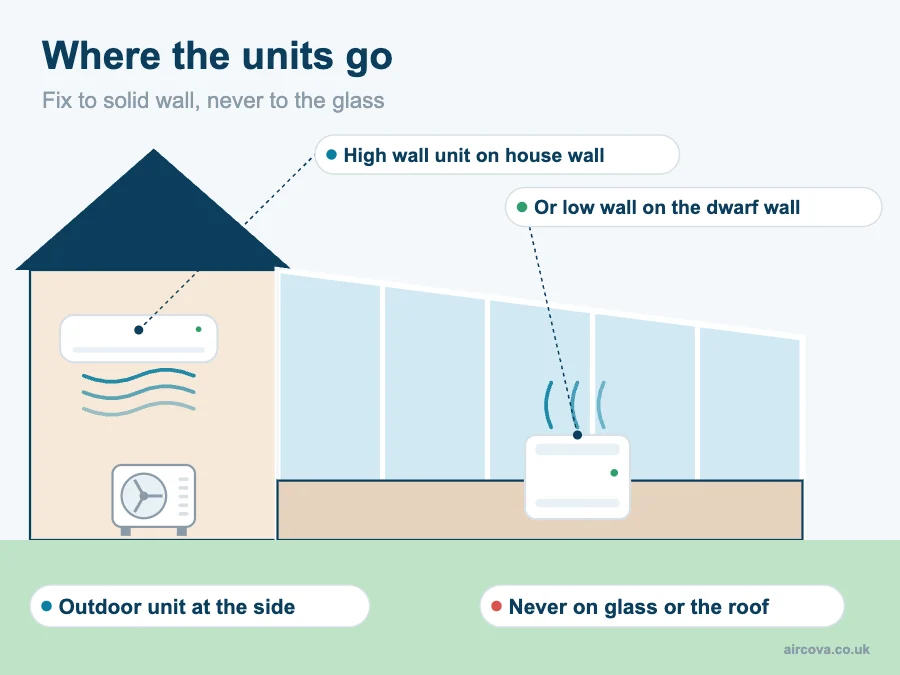
Placement is the part that catches people out. An indoor unit needs a solid wall to fix to, and most conservatories have very little of it.
The indoor unit
- The house wall is usually the best spot. It is solid brick, it is the tallest wall in the room and the pipe can often run straight outside.
- A brick dwarf wall suits a floor-standing console. It sits low, blows warm air along the floor in winter and does not need a tall wall.
- Not on frames or glass. We do not fix units to uPVC or aluminium frames or to glazing panels. They are not designed to carry the weight or the vibration.
The outdoor unit
The outdoor unit goes outside on a wall bracket or ground stand, usually beside the conservatory or on the side of the house. It needs clear space around it for air to flow, and a short pipe run keeps it efficient. Up to 3 metres of pipe is included in our fixed prices.
See wall-mounted air conditioning for unit sizes and finishes, or multi-split air conditioning if you want to cool another room from the same outdoor unit.
Rules and consent
Building regulations and planning permission
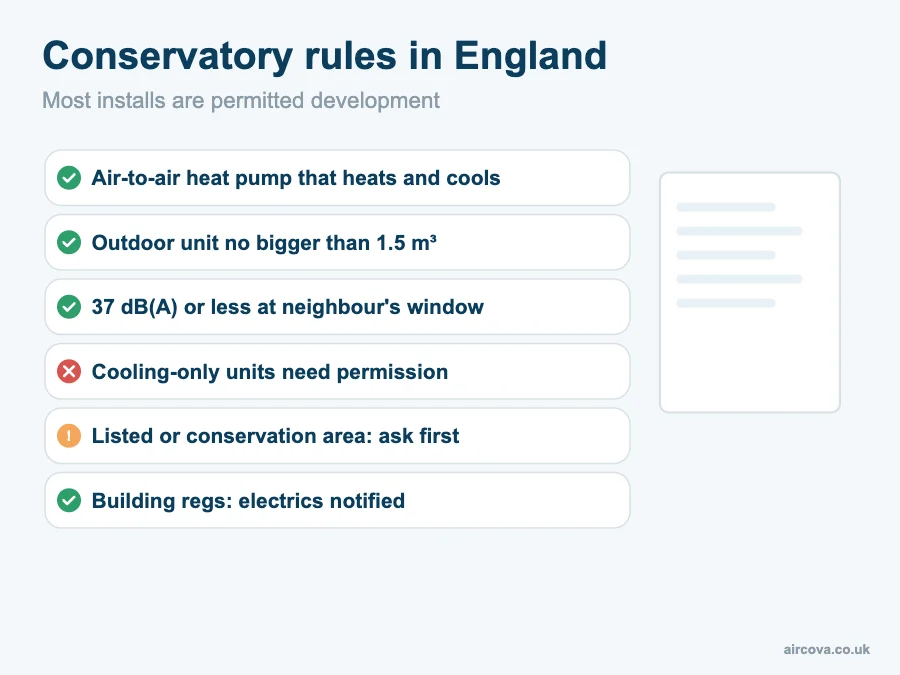
Most conservatories are exempt from building regulations, and the way you heat the room is part of that. According to the Planning Portal, a conservatory is normally exempt when it is:
- at ground level, single storey and under 30m² in floor area
- separated from the house by external quality walls, doors or windows
- heated by an independent system with its own temperature and on/off controls
- fitted with glazing and fixed electrics that meet building regulations
A split system with its own controller fits the third point, which is one reason it suits conservatories better than extending the central heating into them. It still needs a properly installed electrical supply. If you plan to take out the doors between the house and the conservatory, the room may lose its exemption, so check before you start.
The outdoor unit is a separate question. Since May 2025, many split units that heat as well as cool count as permitted development on a house, within size, noise and position limits. Flats, listed buildings and conservation areas have stricter rules. Our air conditioning planning permission guide explains the limits.
Prices
How much does conservatory air conditioning cost?
A fitted wall-mounted split for a conservatory starts from £2,195 with VAT at Aircova. Most conservatories need a 2.5kW or 3.5kW unit, which costs £2,195 to £2,395 fitted. Cooling the conservatory and a second room on a multi-split starts from £3,995.
| Unit size | Typical conservatory | Fitted from |
|---|---|---|
| 2.5kW | Small conservatory up to about 12m², glass roof, not in full sun | £2,195 |
| 3.5kW | Medium conservatory of about 12 to 16m², or a smaller one in full sun | £2,395 |
| 5.0kW | Larger conservatory of about 16 to 22m² in full sun | £2,695 |
| 7.0kW | Large P-shape or L-shape conservatory over about 22m² | £2,995 |
| Multi-split, two rooms | Conservatory plus a bedroom, kitchen or office | £3,995 |
All prices include VAT and up to 3 metres of pipe. Floor-standing consoles, longer pipe runs and difficult access are priced on survey. Our air conditioning cost guide covers UK prices in more detail.
What can push the price up
- A floor console instead of a wall unit, where there is no solid wall high enough
- A long pipe run when the outdoor unit has to sit well away from the conservatory
- Electrical work if your consumer unit needs upgrading for a new circuit
- Access for the outdoor unit, such as a flat roof or a narrow side return
Choosing
Which option is right for your conservatory?
For most conservatories, a wall-mounted split on the house wall is the best value. Choose a floor console where there is no tall solid wall, and a multi-split if another room needs cooling too.
| Your situation | Our usual recommendation |
|---|---|
| Conservatory against a solid house wall | Wall-mounted split on the house wall |
| No tall solid wall, brick dwarf walls only | Floor-standing console on the dwarf wall |
| Want to use it in winter too | Any split that works as a heat pump, sized for winter heat loss |
| A bedroom upstairs also overheats | Multi-split, with one outdoor unit for both rooms |
| Polycarbonate roof you plan to replace | Replace the roof first, then size the unit for the new roof |
| Renting, or only a few hot weeks a year | Blinds and ventilation first, a portable unit for short-term use |
Cheaper fixes worth trying first
Air conditioning is not the only answer, and in a mildly warm conservatory it may not be needed. Roof blinds, solar control film and opening roof vents all cut summer heat. They do nothing for winter, though, which is where a heat pump earns its keep. If you are about to replace the roof, do that first. A unit sized for a polycarbonate roof may be bigger than you need once a solid or modern glass roof is on.
The Energy Saving Trust explains how air-to-air heat pumps heat and cool, and our air-to-air heat pumps page covers how they compare with other heating.
FAQs
Conservatory air conditioning: your questions
Can you put air conditioning in a conservatory?
Yes. A split system with the indoor unit on the house wall or a brick dwarf wall and the outdoor unit outside is the usual choice. Most split units also heat, so the conservatory can be used all year.
What size air conditioner do I need for a conservatory?
Most need 2.5kW to 3.5kW. Allow 100 to 125 watts per square metre, add 40% for a conservatory, 10% for strong sun and 15% for a polycarbonate roof or poor glazing. A 14m² south-facing conservatory with a polycarbonate roof needs about 3.1kW, so a 3.5kW unit.
How much does conservatory air conditioning cost?
At Aircova a fitted wall-mounted split starts from £2,195 for a 2.5kW unit and £2,395 for 3.5kW, including VAT and up to 3 metres of pipe. Larger units cost up to £2,995, and a multi-split for two rooms starts from £3,995.
Can air conditioning heat a conservatory in winter?
Yes, if it is a split unit that works as an air-to-air heat pump, which most modern units are. In a cold or poorly insulated conservatory, winter heat loss can decide the unit size, so we check heating as well as cooling on the survey.
Can an air conditioning unit be fixed to a conservatory frame?
No. Indoor units should be fixed to solid masonry, such as the house wall or a brick dwarf wall. uPVC and aluminium frames and glazing panels are not designed to carry the weight or vibration.
Do I need building regulations approval for conservatory air conditioning?
Usually not. Most conservatories are exempt when they are separated from the house by external quality walls, doors or windows and have an independent heating system with its own controls, which a split system provides. The electrical supply must still meet building regulations.
Is a portable air conditioner good enough for a conservatory?
Usually not for regular use. A portable unit pushes hot air out through a hose, and in a glass room much of that heat comes back in. Most also cannot heat well in winter. It can help on a few hot days, but a fitted split is quieter and far more effective.
Get your fixed price
Tell us the size of your conservatory, which way it faces and what the roof is made of. We will tell you honestly what size and type of unit suits it, where it can go, and send you a fixed price. No pressure and no obligation.
- Reply within an hour
- Free home survey
- Price confirmed in writing
Prefer to chat? WhatsApp us on 07403 664179
Monday to Friday 8am to 6pm, Saturday 9am to 5pm
We only use your details to prepare your quote. See our privacy policy.