
No box outside Monobloc, hidden split and ducted options
Air Conditioning Without an Outdoor Unit: Your UK Options
You can have air conditioning without an outdoor unit. The usual answer is a through-wall monobloc, which needs two small grilles in an outside wall and nothing on the balcony or roof. This guide compares it with hidden split, ducted and portable options, with real noise, cost and efficiency figures. Aircova fits air conditioning across London and the South East, at a fixed price in writing.
- Figures from manufacturer spec sheets
- Honest advice on what suits your home
- F-Gas certified engineers
Last updated: October 2026. Prices last checked: October 2026
See how it works
Air conditioning without an outdoor unit in three short clips
How a monobloc works, what you give up, and the other options if you do not want an outdoor unit.
The short answer
Can you have air conditioning without an outdoor unit?
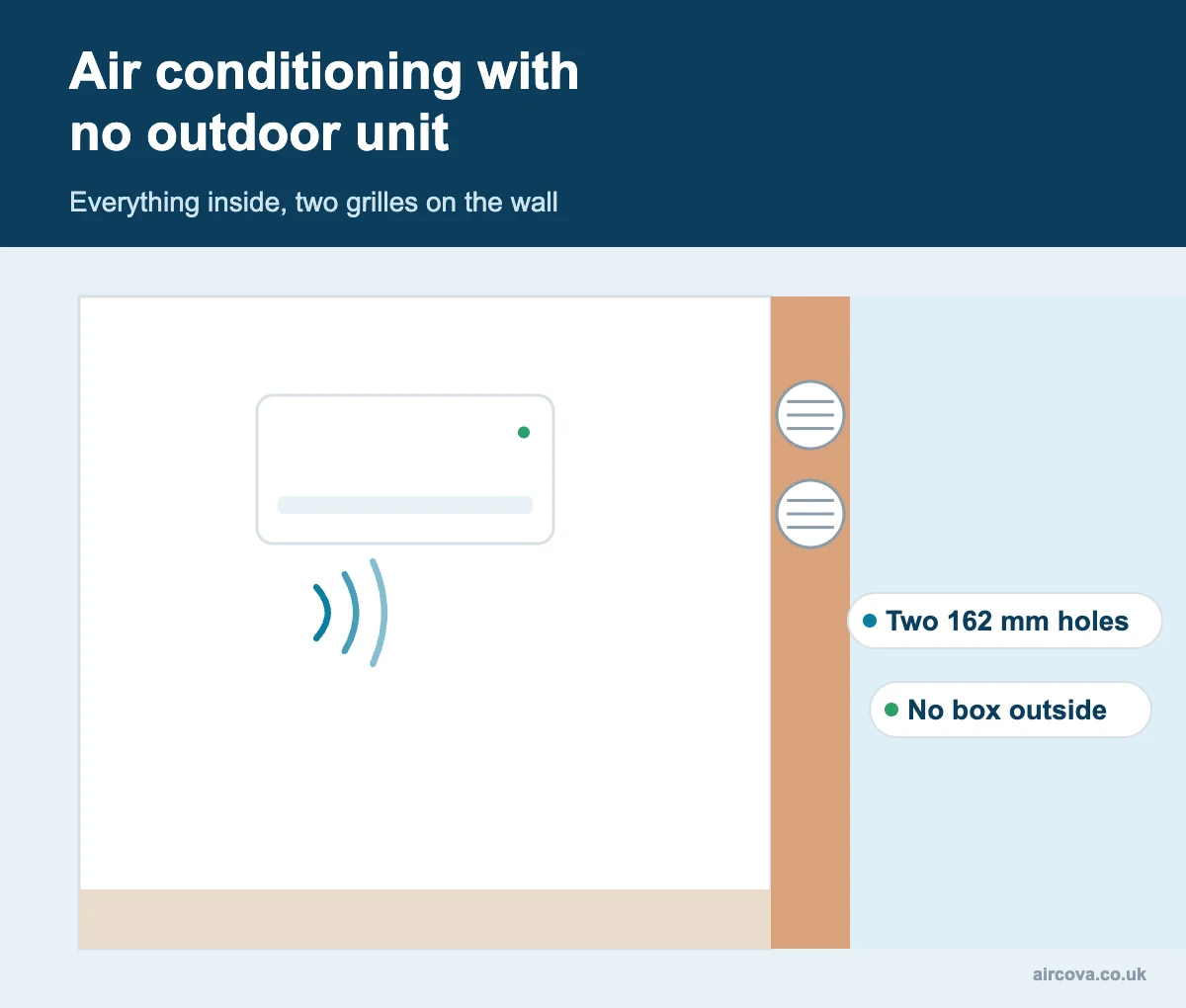
Yes. A through-wall monobloc air conditioner has no outdoor unit. It sits on the inside of an outside wall and uses two round holes, covered by small grilles. It suits one small to medium room, but it is louder indoors and less efficient than a split system, because the compressor sits in the room with you.
Most people looking for this have a real reason. A freeholder has refused a box on the balcony, the house is in a conservation area, or they simply do not want a condenser on show. Each option below trades something for a clean exterior, usually noise, running cost or cooling power.
| Option | What you see outside | Indoor noise | Best for |
|---|---|---|---|
| Through-wall monobloc | Two grilles, about 16 to 20cm across | About 31 to 43 dB(A) | One room where no outdoor unit is allowed |
| Split with a hidden outdoor unit | Outdoor unit, placed out of sight | From about 19 dB(A) on quiet models | Homes where a unit is allowed but must be discreet |
| Ducted split | Outdoor unit, with the indoor unit hidden in the ceiling | Soft airflow at the grilles | Renovations wanting nothing on the walls |
| Portable unit | A hose out of a window | About 50 to 65 dB | Renters and short-term use |
Sources: monobloc figures from the Panasonic RAC Solo and Olimpia Splendid Unico data sheets. Split figures from the quiet models in our quietest air conditioning guide.
Living in a flat? Freeholder consent is usually the deciding factor. Our page on air conditioning for flats explains how consent works and where an outdoor unit can usually go.
Through-wall units
How a monobloc air conditioner works
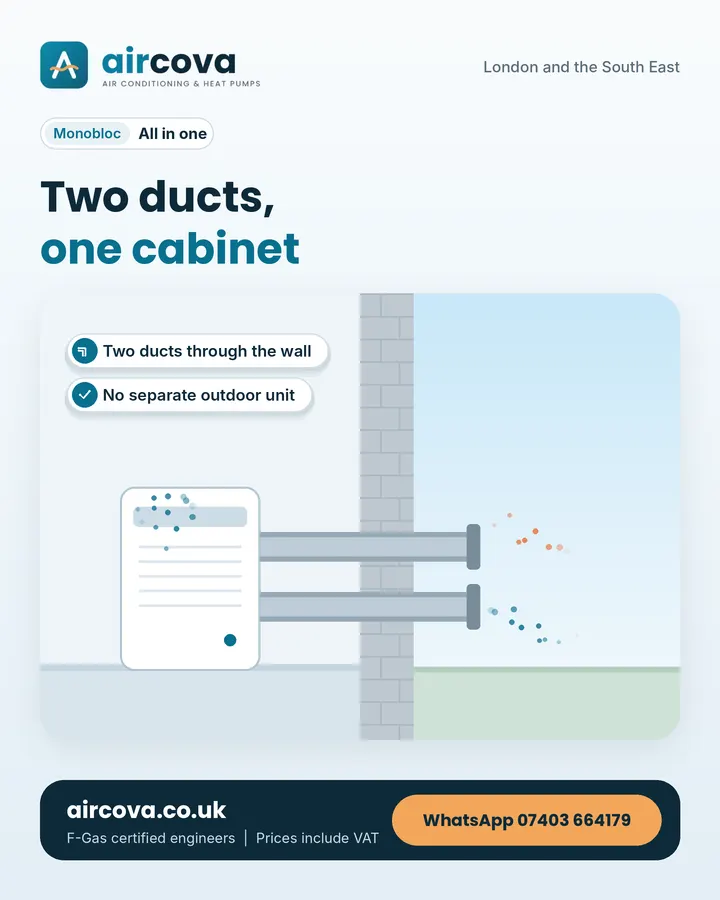
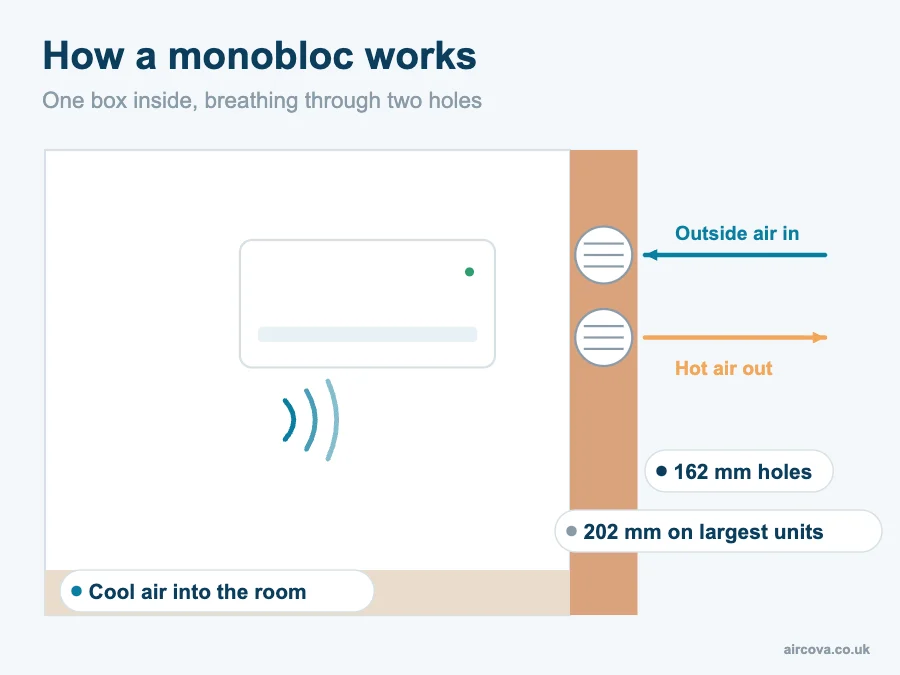
A monobloc, also called an all-in-one or through-wall air conditioner, puts everything in one cabinet: the compressor, the fans and both coils. It mounts on the inside of an outside wall. Two holes go straight through the wall behind it. One draws outside air in to carry heat away, and the other pushes it back out.
Inside, it is bigger than a normal wall unit. The Panasonic RAC Solo 2.5kW measures about 101cm wide, 55cm high and 16.5cm deep. Outside, you only see two round grilles, which can usually be painted to match the wall.
Monobloc vs split: the real figures
| Feature | Monobloc (Panasonic RAC Solo 2.5kW) | Quality split system |
|---|---|---|
| Wall holes | Two, 162mm each (202mm on the largest model) | One, about 65mm |
| Nominal cooling | 2.33kW (max 3.1kW) | 2.5kW to 7kW or more per room |
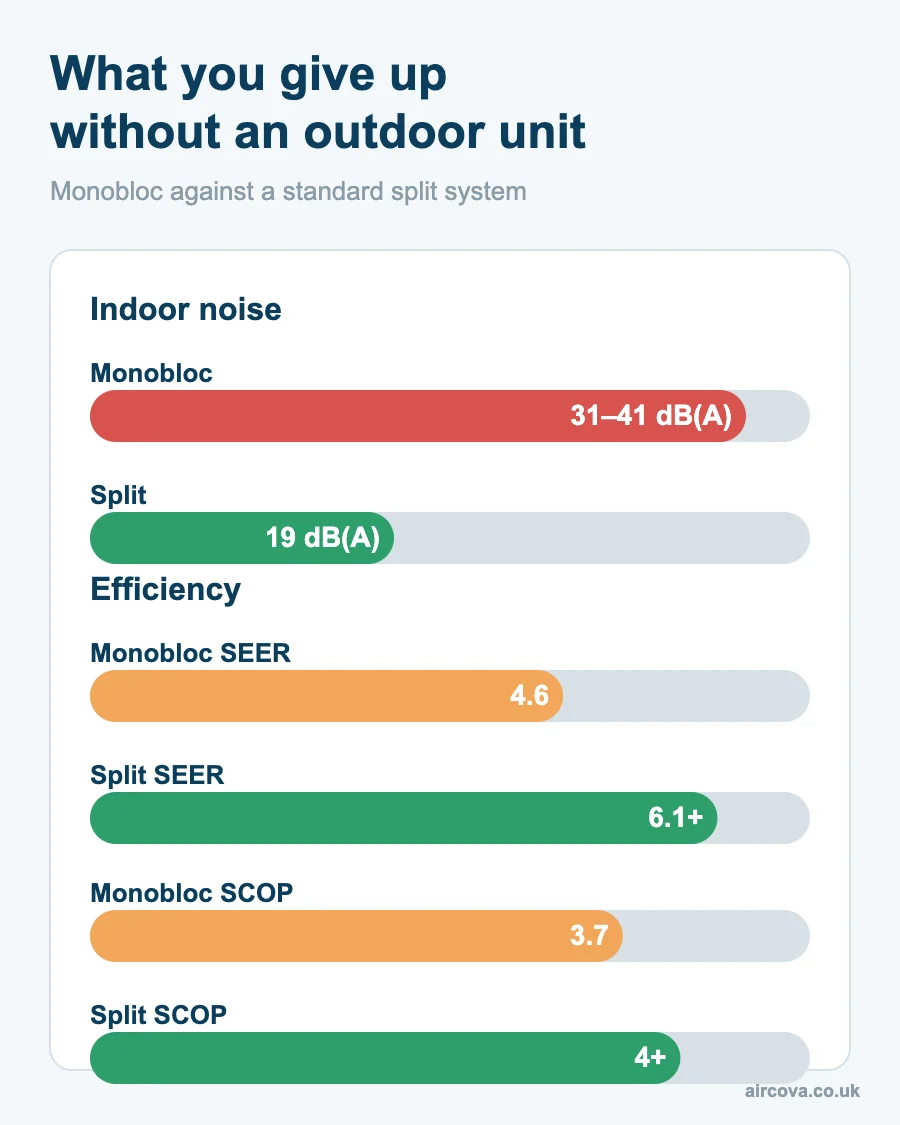
| Indoor noise | 31 to 41 dB(A) at 2 metres | From about 19 dB(A) in quiet mode |
| Cooling efficiency | SEER 4.6 (B rating) | Many models A++ (SEER 6.1 or above) |
| Heating efficiency | SCOP 3.7 | SCOP around 4 |
| Heat output at -7°C | 1.52kW | Usually higher, depending on model |
Source: Panasonic RAC Solo P-MOZ25IC5-E specifications.
Pros of a monobloc
- No outdoor unit on the balcony, roof or wall
- Two painted grilles are far less visible than a condenser
- Often fitted from inside, so upper floors may not need scaffolding
- Sealed at the factory, so there is no refrigerant pipework to run
- Many models heat as well as cool
Cons of a monobloc
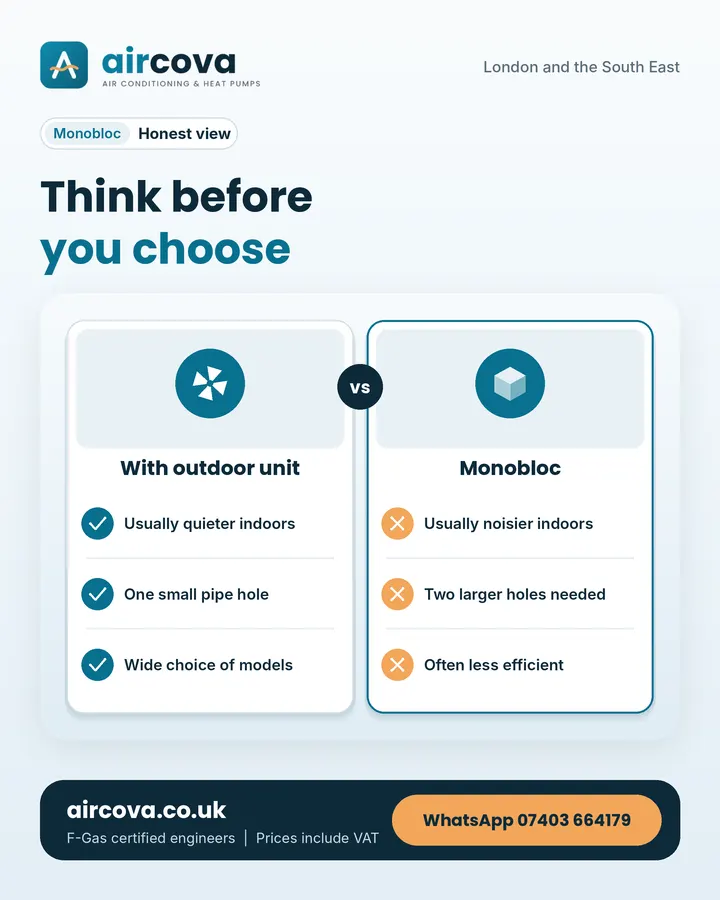
- Louder indoors. At 31 dB(A) or more on low speed, light sleepers may notice it in a bedroom.
- Higher running costs. A lower SEER means more electricity for the same cooling.
- Limited power. Most models top out around 3 to 3.5kW, enough for one room, not an open plan floor.
- Two large holes. Core drilling 162mm or 202mm holes is a bigger job, and the unit must sit on an outside wall.
- Consent may still apply. The grilles still change the outside of the building.
What does a monobloc cost?
The unit alone costs more than many people expect. In October 2026, the Panasonic RAC Solo range was listed at about £1,730 to £1,995 including VAT for the unit only at one UK retailer, with grille kits often sold separately. Fitting adds core drilling, a power supply and making good.
That puts a fitted monobloc in a similar band to a one room split system, which starts from £2,195 fitted at Aircova. You pay a similar amount for more noise and lower efficiency, so a monobloc makes most sense when a split genuinely is not allowed. See our air conditioning cost guide for split prices by size.
Hide it, don’t lose it
A split system with a hidden outdoor unit
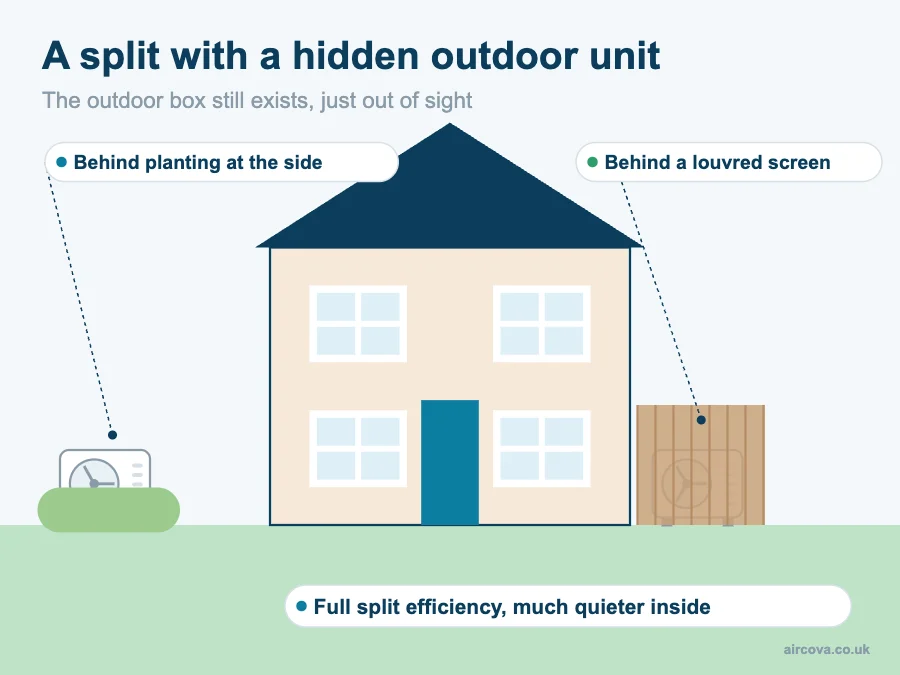
Often the real problem is not the outdoor unit itself, it is where it goes. If an outdoor unit is allowed somewhere on the building, a good installer can usually find a spot you will not see from the street or your windows.
- Flat roofs on rear extensions or the main building, out of sight from the ground
- Side returns on Victorian and Edwardian terraces
- Ground stands behind a garden wall, planter or fence
- Rear walls instead of the front, which matters most in conservation areas
- Longer pipe runs, so the unit can sit away from the room it serves
Decorative covers can help too, but they must leave enough open space for air to flow. A boxed-in condenser overheats, runs inefficiently and can affect the warranty, so we always follow the manufacturer’s clearance distances.
You keep the big advantages of a split: very quiet rooms, better efficiency and a choice of sizes. See wall-mounted air conditioning for room sizes and prices, or multi-split air conditioning to run up to five rooms from one outdoor unit.
In numbers
What you give up without an outdoor unit
Putting the compressor inside the room is what makes a monobloc possible, and it is also where the compromises come from. These figures compare a typical monobloc with the quiet split systems we fit.
About 10 dB is heard as roughly twice as loud, so the gap is easy to notice in a quiet bedroom at night. In a home office or living room, many people find a monobloc perfectly acceptable.
Running costs follow efficiency. For the full sums on what a split costs per hour and per year, see our air conditioning running costs guide.
Other options
Hidden indoor units and portable air conditioners
Ducted air conditioning hides the indoor unit
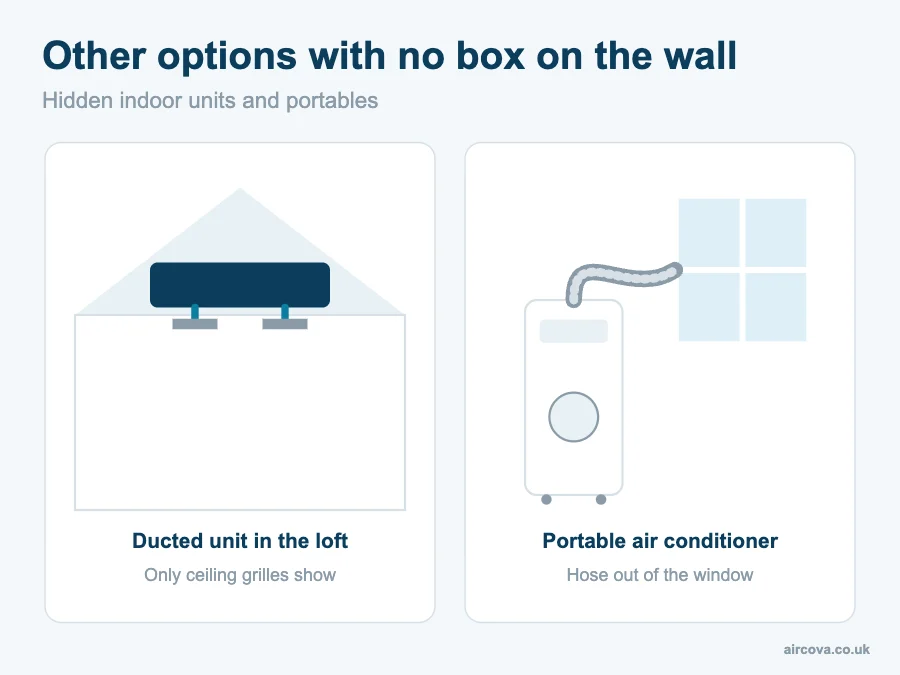
Some people searching for hidden air conditioning mean the opposite problem: they do not want a unit on the inside wall. A ducted system hides the indoor unit in the loft or a ceiling void, and each room shows only a slim grille.
It still needs an outdoor unit, but it gives the cleanest look indoors. It suits renovations, loft conversions and period homes where a white wall unit would clash with cornicing. Read more about ducted air conditioning, including the ceiling space you need.
Portable units need no fixing at all
A portable unit sits on the floor and pushes hot air out through a hose in a window. Nothing is fixed to the building, so no consent is needed, which makes it handy for renters.
The downsides are real. It is the loudest option, the window cannot close fully and warm air leaks back in. For more than a few hot weeks a year, a fixed system is better value. Our portable vs split air conditioning guide compares them in detail.
Consent and planning
Do you need permission for a unit with no outdoor box?
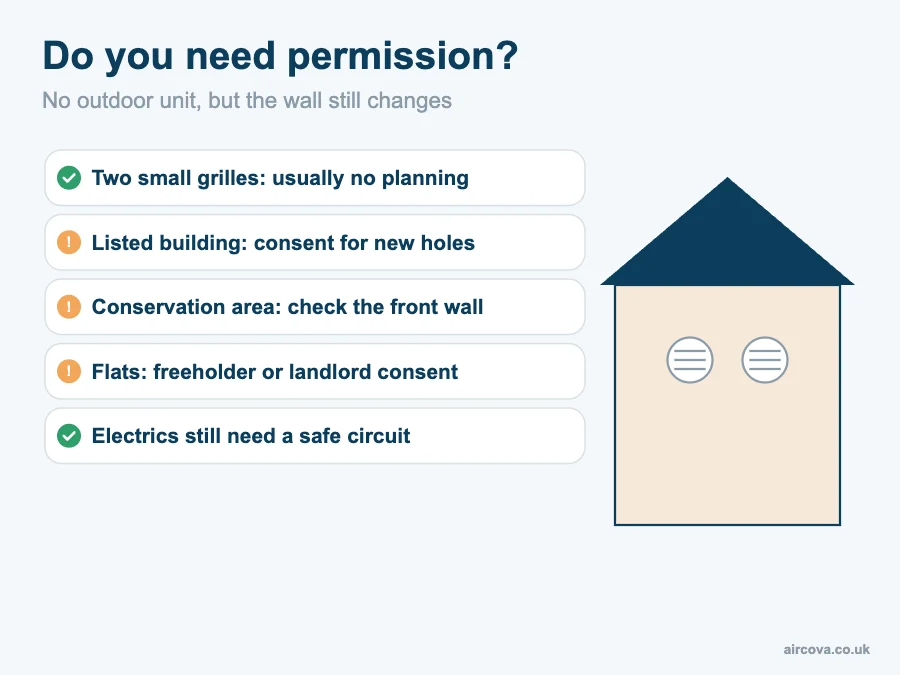
Not always, but do not assume you are in the clear. Monobloc grilles are small, yet they still alter the outside wall. Check these before you book:
- Flats: most leases need freeholder consent for any change to the outside walls, including new holes.
- Listed buildings: drilling through a listed wall usually needs listed building consent.
- Conservation areas: grilles on a front wall may need permission, and a rear wall is usually easier.
- Houses: many small units need no planning permission, but local rules vary.
Our air conditioning planning permission guide covers the common cases. If in doubt, ask your council before any drilling starts.
Choosing
Which option is right for your home?
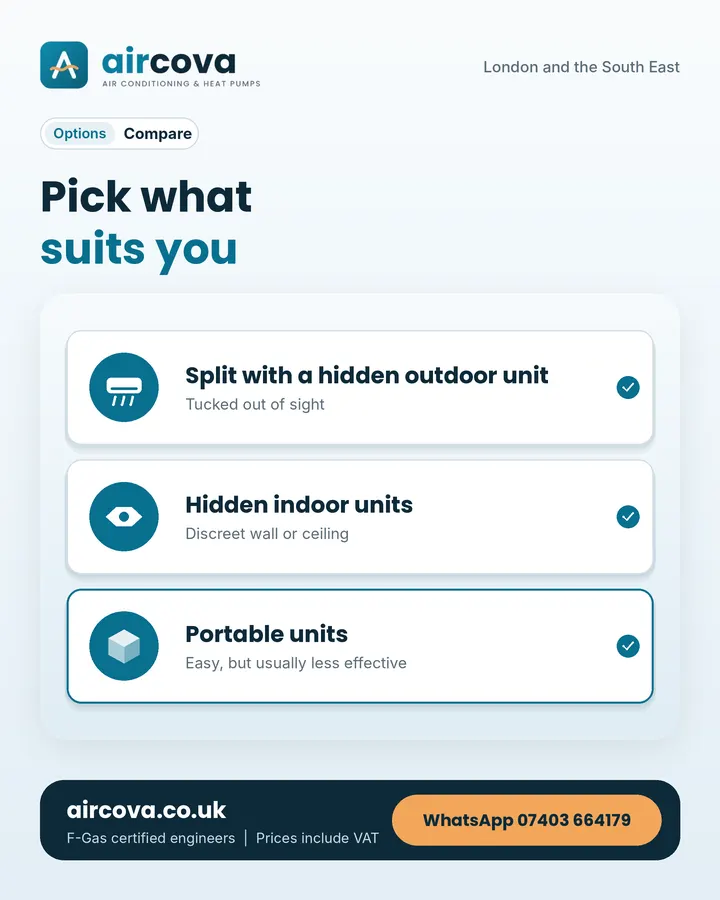
Choose a monobloc only when an outdoor unit is not allowed anywhere. If one is allowed but must be discreet, a split with a hidden outdoor unit is quieter and cheaper to run.
| Your situation | Our usual recommendation |
|---|---|
| Flat, freeholder refuses any outdoor unit | Through-wall monobloc, with consent for the grilles |
| Flat or house, outdoor unit allowed at the back | Split system with the outdoor unit out of sight |
| Bedroom for a light sleeper | Split system, ideally a quiet model from about 19 dB(A) |
| Renovation or loft conversion | Ducted system, with nothing on the walls |
| Renting, no consent possible | Portable unit for short-term use |
| Open plan space over about 25m² | Split system, as most monoblocs lack the power |
Two typical examples
Mansion block flat. A second floor flat with a lease that bans external units. The main bedroom faces the street and gets hot by late afternoon. A monobloc on the bedroom’s outside wall, with grilles painted to match the brickwork, is the practical answer, subject to freeholder consent for the two holes.
Victorian terrace. The same bedroom in a terrace with a side return is better served by a quiet split, with the outdoor unit tucked into the side return where nobody sees it. Not sure what size you need? Try our BTU calculator.
FAQs
Air conditioning without an outdoor unit: your questions
Can you get air conditioning without an outside unit?
Yes. A through-wall monobloc air conditioner has no outdoor unit. It sits on the inside of an outside wall and uses two holes with small external grilles. Portable units also work without an outdoor unit, using a hose through a window.
Are air conditioners without an outdoor unit any good?
They work well for one small to medium room, and many also heat. They are louder indoors and less efficient than a split system, because the compressor is in the room. If a split is allowed, it is usually the better choice.
How loud is a through-wall air conditioner?
Typical models are rated at about 31 to 43 dB(A) indoors, depending on fan speed. The quietest split systems run from about 19 dB(A), which is why splits suit bedrooms better.
Can a wall-mounted air conditioner without an outdoor unit heat a room?
Many can. The Panasonic RAC Solo is a heat pump with a SCOP of 3.7. Heat output drops in cold weather, to about 1.5kW at -7°C on the 2.5kW model, so it works better as top-up heating than as the only heat in a cold room.
How big are the holes for a monobloc air conditioner?
Most need two holes of 162mm, and some larger models need 202mm. A split system needs just one hole of about 65mm.
Do I need planning permission for a through-wall air conditioner?
It depends on your home. Flats usually need freeholder consent, listed buildings usually need listed building consent, and conservation areas may need planning permission for grilles on a front wall. Check with your council and, in a flat, your freeholder first.
Is a monobloc cheaper than a split system?
Usually not by much. Premium monobloc units cost about £1,730 to £1,995 for the unit alone, before fitting. A fitted one room split system starts from £2,195 at Aircova, so the total cost is often similar.
Get your fixed price
Tell us about the room, your building and any limits from your freeholder or council. We will tell you honestly whether a hidden split, a ducted system or a no outdoor unit option fits, and send you a fixed price. No pressure and no obligation.
- Reply within an hour
- Free home survey
- Price confirmed in writing
Prefer to chat? WhatsApp us on 07403 664179
Monday to Friday 8am to 6pm, Saturday 9am to 5pm
We only use your details to prepare your quote. See our privacy policy.